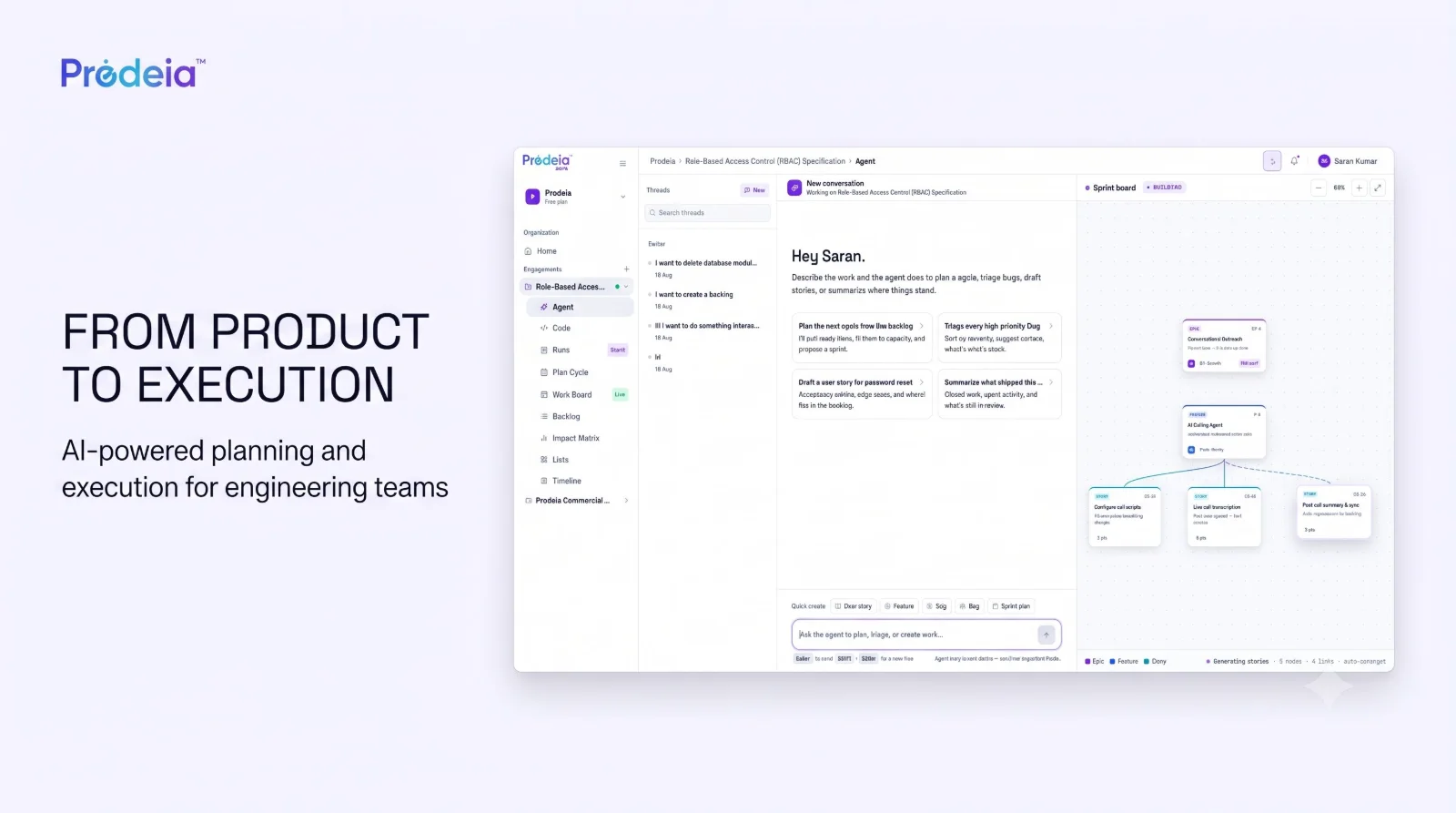
Product Analyst - Prodeia
Built an AI-native product development workflow that connects product strategy with engineering execution. Worked across discovery, product strategy, prototyping, requirements, Agile delivery and validation to reduce the gap between what product teams plan and what engineering teams build.
Problem
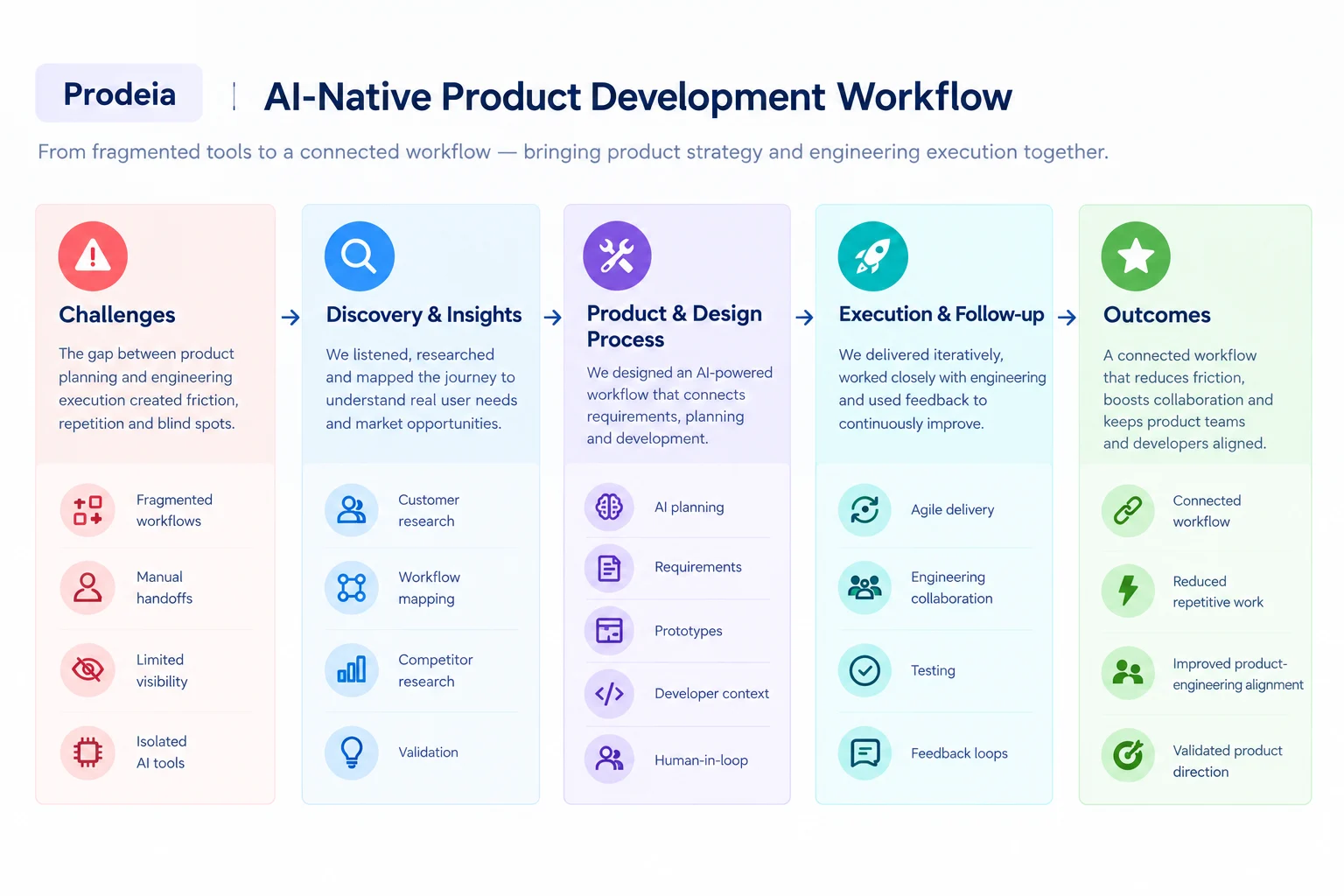
- Product and engineering workflows were fragmented, with requirements, planning, documentation and development happening across different tools and environments.
- Product requirements often required repeated interpretation and handoffs, creating opportunities for ambiguity between product intent and technical implementation.
- Product teams had limited visibility into implementation progress, while developers had to repeatedly switch between product-management tools, documentation and development environments.
- AI coding tools were becoming increasingly capable, but operated separately from the broader product-development workflow, limiting the product context available during implementation.
Key Insights
- Conducted customer discovery and workflow research to understand how product and engineering teams move from an idea or requirement to implementation.
- Mapped product-to-engineering journeys to identify where information was lost, duplicated or manually translated between teams.
- Studied existing PM and AI development workflows to understand where conventional tools supported planning but stopped short of execution.
- Identified a broader opportunity: instead of another standalone PM or AI coding tool, connect the two sides of the workflow.
Solution
- Connected product planning with engineering execution, carrying product context from requirements into implementation.
- Introduced AI-assisted implementation planning, translating product requirements into structured engineering work.
- Enabled AI-assisted development workflows, giving coding agents greater awareness of product and implementation context.
- Kept humans in the loop, positioning AI as an accelerator rather than a replacement for product or engineering ownership.
Implementation Process
- Worked directly with leadership and cross-functional teams to translate the product vision into an actionable strategy and roadmap.
- Led product discovery and validation, converting customer problems and workflow observations into product opportunities.
- Created prototypes and product workflows to test concepts before committing engineering resources.
- Translated validated concepts into structured requirements - user stories, acceptance criteria, documentation - using Agile delivery to prioritize, build and refine.
Handling Challenges
-
Moving Beyond Another PM Tool
- The product needed to address the disconnect between planning and actual engineering execution - not simply add more planning functionality. Focused the product around the complete workflow rather than another standalone backlog experience.
-
Designing AI Into an Existing Workflow
- AI needed to provide meaningful assistance without taking ownership away from PMs and developers. Designed workflows around AI assistance plus human review and decision-making.
-
Translating Ambiguous Requirements
- Product requirements can carry business intent without enough implementation context. Focused product direction on making requirements progressively more actionable before they reached development.
-
Balancing Ambition With Usability
- Connecting PM workflows, AI planning and developer workflows introduces significant complexity. Product decisions had to balance automation with clarity, control and adoption.
-
Validating Direction in a Shifting Market
- The AI development landscape was evolving rapidly. Used continuous customer discovery, competitive analysis and experimentation to validate where Prodeia could create meaningful workflow value.
Results
- Scaled the platform from zero to hundreds of paying customers with the CEO, across four product iterations shaped by 100+ customer interviews.
- Doubled MRR in three months by using RICE to prioritise a tool automation agent, lifting feature adoption 25% and retention 40%.
- Cut onboarding drop-off from 30% to 10% and lifted activation 12% by redesigning a six-step flow into five, validated through A/B testing.
- Raised AI agent tool-calling accuracy from 60% to 90% through 50+ human-verified test cycles, and cut inference cost 30% with complexity-based model routing.
- Built an MCP integration that let customers use the in-product AI coding agent inside their own IDE.
- Delivered 50+ features across 28 Agile sprints and 4 major releases, backed by 500+ user stories and 30+ BRDs, PRDs and FRDs.
- Earned the Quarterly CEO Award (Nov 2025) and the Promising New Talent Award (Aug 2025) from Nuivio Ventures.